What an omnichannel shop really costs a two-store retailer
The base plan is just line one. See how a "base + POS add-on + apps" stack adds up across two locations plus an online store — vs one all-in-one price.
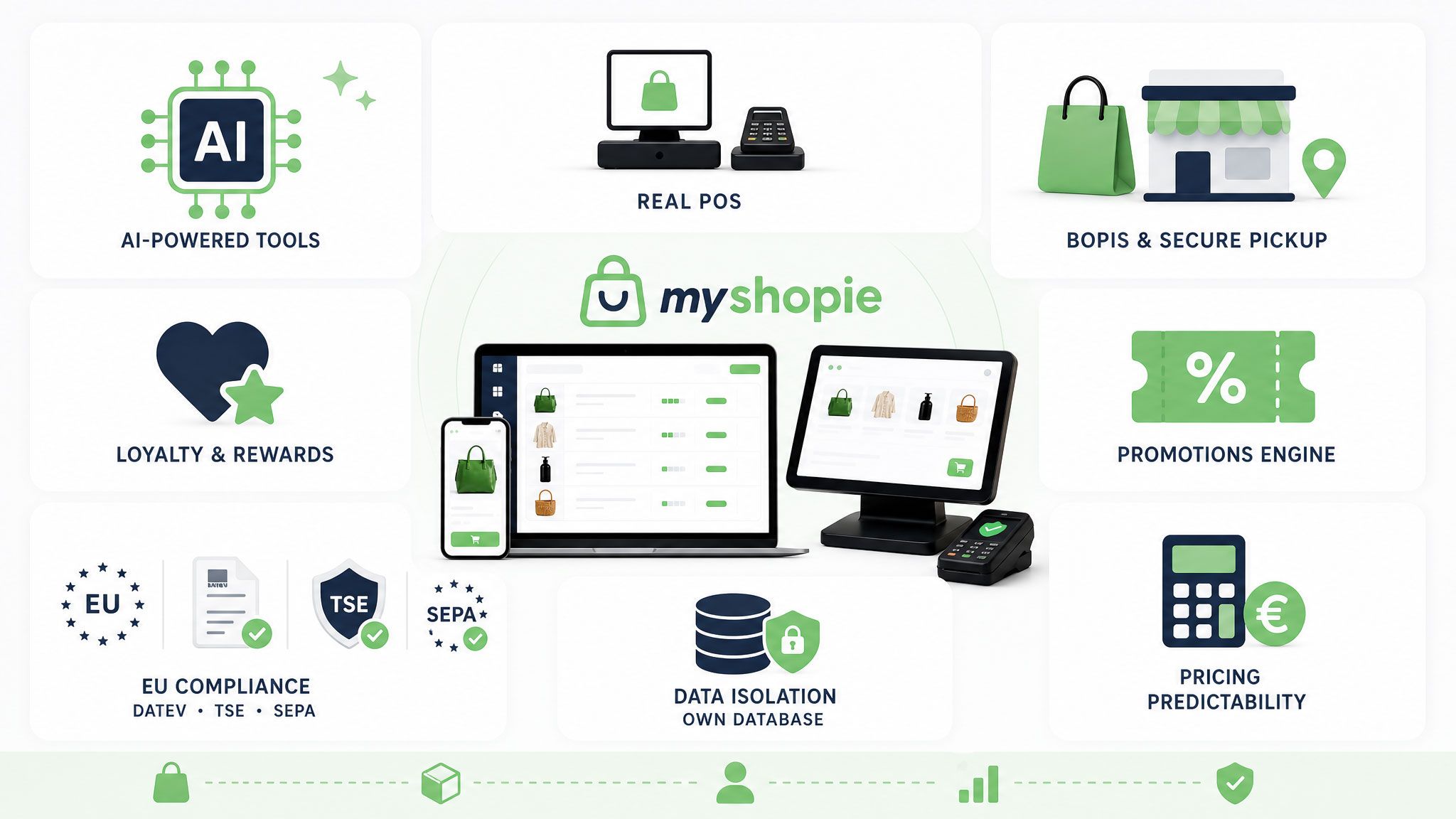
When you price an omnichannel setup, the headline number is the base ecommerce plan. It is also the smallest number you will ever see. The real total is what you assemble on top of it to actually run two shops and a website as one business.
Here is the honest way to add it up.
Start with the base plan, then keep going
A hosted ecommerce plan gets you a storefront and online checkout. That is genuinely useful — but on its own it does not ring up a sale at your counter, it does not reconcile a cash drawer, and it does not let a customer collect an online order in-store. Each of those is a separate line.
For a retailer with two locations plus an online store, a typical assembled stack looks like this:
- Base ecommerce plan — the storefront and online checkout.
- A point-of-sale add-on — usually priced per location, so two shops means paying it twice.
- Loyalty — a separate paid app.
- Promotions and automatic discounts — often another paid app once you outgrow basic coupon codes.
- In-store pickup / BOPIS — frequently a third app, or a manual workaround.
None of these are exotic. They are the baseline for a shop that sells both online and over the counter. But because they arrive as add-ons and third-party apps, the monthly total drifts well above the plan price you first quoted yourself — and every app is a separate bill, a separate login, and a separate thing that can break on a Saturday afternoon.
The line nobody puts on the quote
There is a cost that never appears on any pricing page: the integration tax. When your POS, your loyalty app, and your promotions engine are made by different vendors, you are the integration layer. Stock that looks right online is wrong at the register. A loyalty point earned in-store does not show up in the online account. A promotion runs in one channel and not the other.
That is not a line item, but it is real money — in staff time, in reconciliation, and in the sales you lose when the two sides of your business disagree with each other.
What “all-in-one” actually changes
The alternative is not a cheaper base plan. It is a different shape of bill.
With MyShopie, the POS, secure in-store pickup, loyalty, and the promotions engine are included in one subscription — not stacked as per-location add-ons and paid apps. Illustratively, the all-inclusive tiers sit around €29, €99 and €249 per month, with Enterprise custom. POS, loyalty, promotions and pickup are part of the plan, not extras. You bring your own domain and your own Stripe account, and MyShopie takes no cut of your sales — standard card fees stay between you and Stripe.
The point is not that one number is smaller than another. It is that one number replaces five, and the integration tax disappears because it is one platform keeping both channels in agreement.
How to run the comparison for your own shop
Do not compare base plan to base plan. Compare the whole stack you actually need:
- Write down every capability you use today — POS, pickup, loyalty, promotions, multi-location stock.
- Price each one the way you really pay for it (POS times the number of locations, every app at its real tier).
- Add the integration tax honestly — the hours someone spends every week keeping channels in sync.
- Put that total next to a single all-inclusive price.
That is the number that matters. If you want to see it for your own location count and add-ons, the all-in-one math calculator does exactly this comparison, line by line.